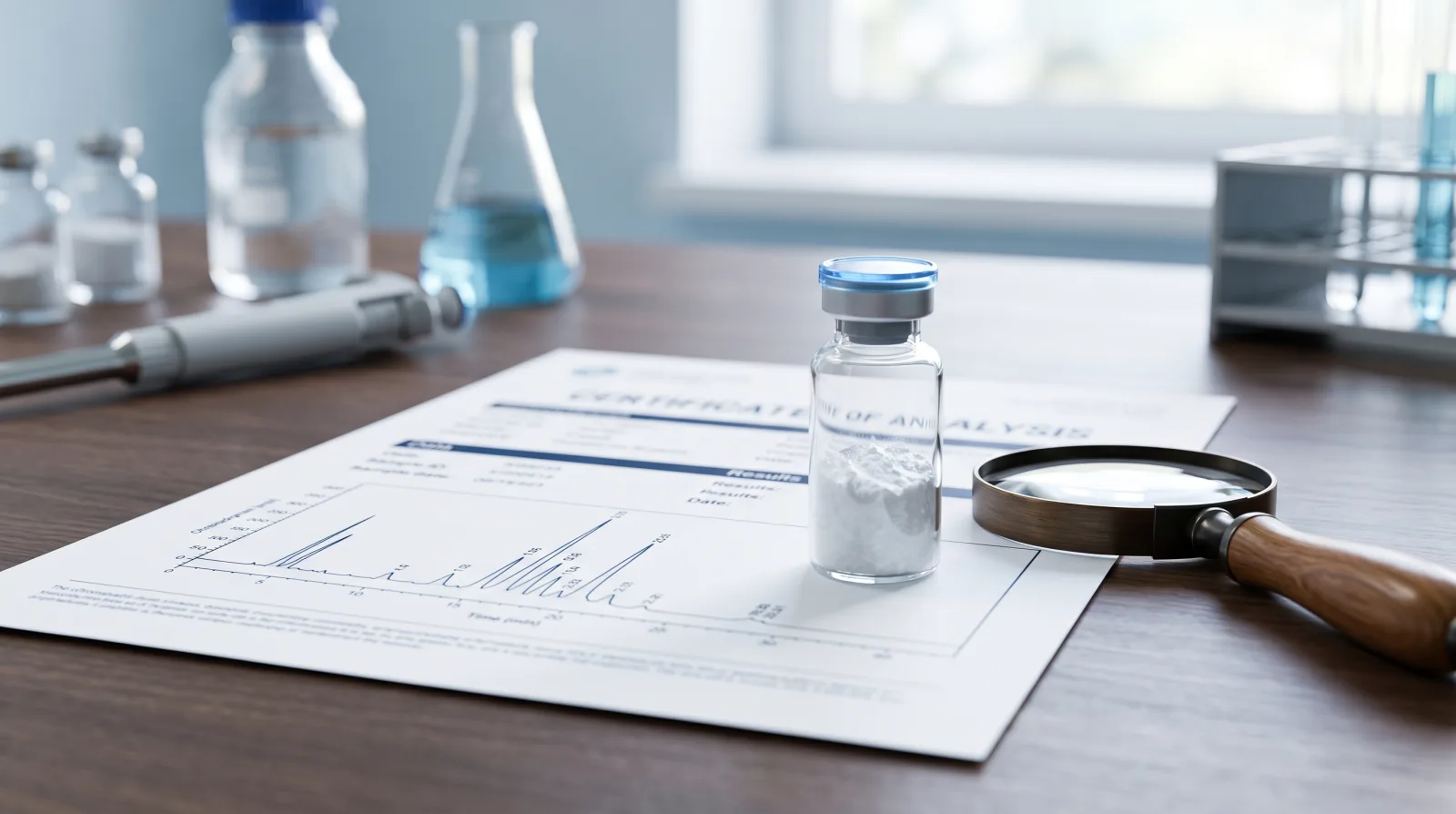
"Third-party tested" is close to meaningless the way it's usually printed on a peptide site — tested for what, by whom, and which lot? A Certificate of Analysis (COA) answers those questions with numbers. Learning to read one takes about five minutes and it's the single most useful skill when qualifying research material.
Start with the lot number and dates
The most important field is the lot number, because it ties the document to the exact vial in your hand. Check that the lot on the COA matches the lot printed on your vial. A vendor that shows one "sample" COA for every batch forever is publishing marketing, not results. Manufacture and retest/expiry dates should bracket your purchase sensibly.
Appearance
A simple line, but a real check: lyophilized peptides are typically a white cake or powder (GHK-Cu is a notable blue exception because of its bound copper). "Conforms" against a stated appearance is your first, cheapest identity check.
Identity — by mass spectrometry
Identity confirms the vial contains the compound named, not a cheaper lookalike. For peptides this is done by mass spectrometry (ESI-MS or MALDI): the certificate reports the expected (theoretical) mass and the found mass. They should agree within instrument tolerance.
This matters most for modified analogs. A GLP-1 peptide with a fatty-acid side chain, for example, has a theoretical mass that includes that side chain — cheap material missing the modification will show a different mass. The MS line is where that failure is caught.
Purity — by HPLC
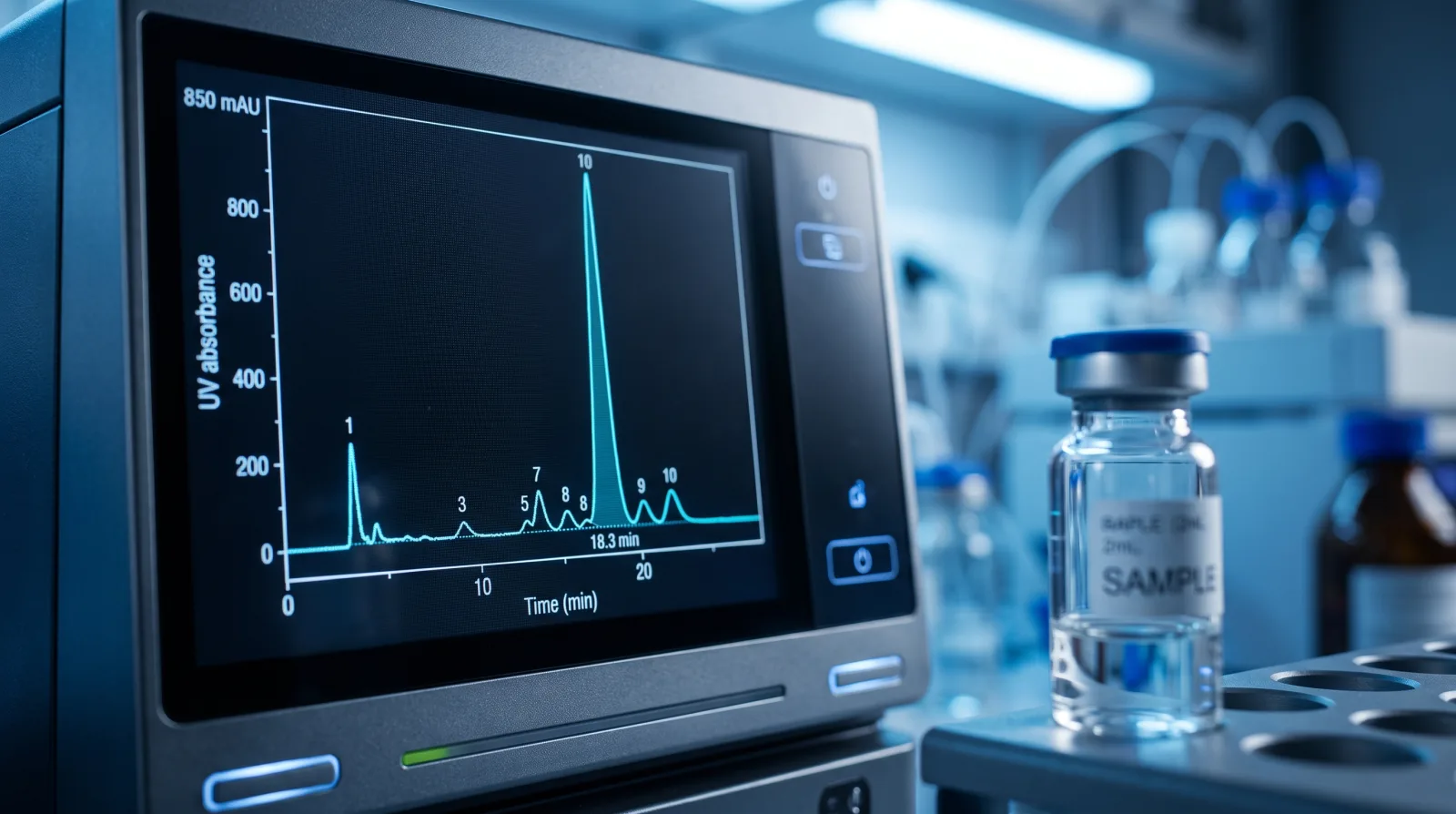
Purity (usually reversed-phase HPLC) measures what fraction of the material is the target peptide versus related impurities, reported as a percentage of chromatographic area against a spec like ≥98.0%. A good COA shows the value and often the chromatogram — you're looking for a single dominant peak. A single-largest-impurity line (e.g. ≤1.0%) tells you no single contaminant dominates.
Net peptide content — the number people miss
Here's the one that trips up new buyers: a "5 mg vial" is 5 mg of net peptide, but the physical mass in the vial also includes bound water and counterion (typically acetate or TFA). Net peptide content — often 80–92% — is what you use to calculate real working concentrations. Ignoring it can put your dosing off by 10–20%. Good COAs report it explicitly, alongside water content (Karl Fischer) and acetate/TFA content.
Safety lines
- Bacterial endotoxin (LAL): reported in EU/mg against a limit; relevant for any research where endotoxin would confound results.
- Bioburden / sterility: confirms the lyophilized material isn't carrying microbial passengers.
Red flags in thirty seconds
- No lot number, or the lot doesn't match the vial.
- Purity with no identity — HPLC % but no mass-spec confirmation.
- No net peptide content (so you can't calculate real concentrations).
- One ancient COA reused for every product and batch.
- A vendor that claims testing but publishes nothing at all.
Why we publish everything
Our position is simple: if the analysis happened, the data exists, and if the data exists, a researcher should see it before ordering. Every lot we sell has its COA published in the lab-results library, searchable by the lot number on your vial. That's what "tested" should have meant all along.
For laboratory research use only. Products discussed are reference materials, not drugs or supplements, and are not for human or veterinary use, diagnosis, treatment, or consumption. This article is educational and does not describe or endorse any in-vivo use.